
Advanced Testing Laboratory
Ensuring Purity, Quality and Global Standards
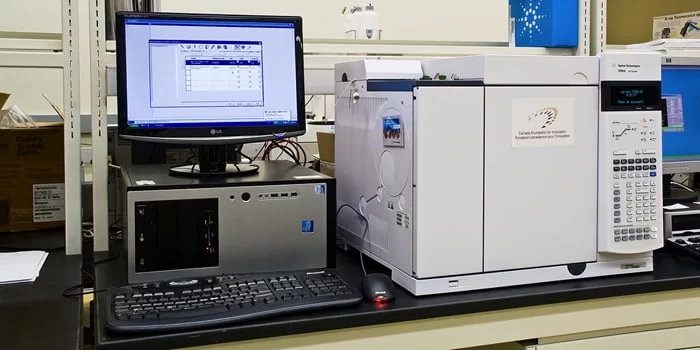
Gas Chromatography
Gas chromatography is the workhorse technique for analysing aromatic materials. It separates a complex mixture into its individual volatile components, so each one can be seen and measured on its own.
How it works
A tiny sample is vaporised in a heated inlet and swept by an inert carrier gas through a long, very thin column lined with a special coating. Compounds that boil at lower temperatures, or that cling less to the coating, travel faster and leave the column first. A detector at the far end records each compound as it emerges.
Reading the result
The output is a chromatogram, a line with a series of peaks:
- The position of a peak (its retention time) shows which compound it is, by comparison with reference standards.
- The size of a peak (its area) shows how much of that compound is present.
Why it matters for essential oils and attars
A natural oil is made up of dozens or even hundreds of compounds, and their proportions form a recognisable fingerprint. GC makes that fingerprint visible, which helps to:
- confirm that an oil matches its expected composition
- spot dilution, added synthetic ingredients or cheaper oils blended in
- check that key marker compounds sit within the expected range
- compare one batch with the next for consistent quality
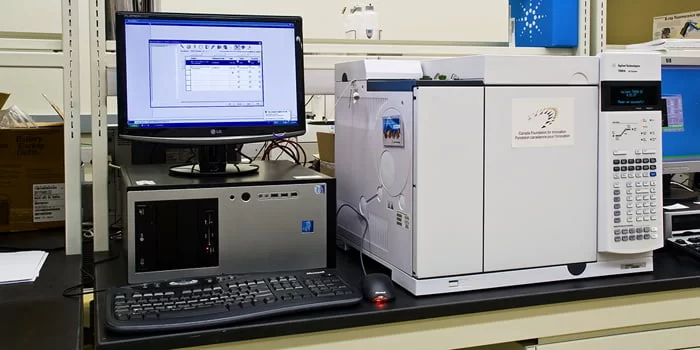
Gas Chromatography–Mass Spectrometry
GC-MS joins two techniques: gas chromatography separates the sample, and a mass spectrometer identifies each compound as it comes off the column. It is widely regarded as the reference method for analysing essential oils and fragrance materials.
How it works
As each separated compound leaves the column, it is ionised and broken into charged fragments. The mass spectrometer sorts those fragments by mass, producing a mass spectrum, a pattern that is characteristic of the molecule, much like a fingerprint. The pattern is compared with reference libraries to name the compound.
What it tells us
- Identification: names the individual compounds in an oil, including ones that were not expected.
- Quantification: measures the amount of major and minor components, using calibration standards.
- Purity checks: reveals adulterants, synthetic additives and residual solvents.
- Batch comparison: shows whether one batch matches another in composition.
- Documentation: supports the composition data that some markets require, such as declarations of fragrance allergens.
A note on accuracy
Many compounds in essential oils are close relatives with very similar spectra. For a confident result, the spectrum match is confirmed against the compound's retention index, a measure of how long it takes to leave the column, and where possible against a pure reference standard.
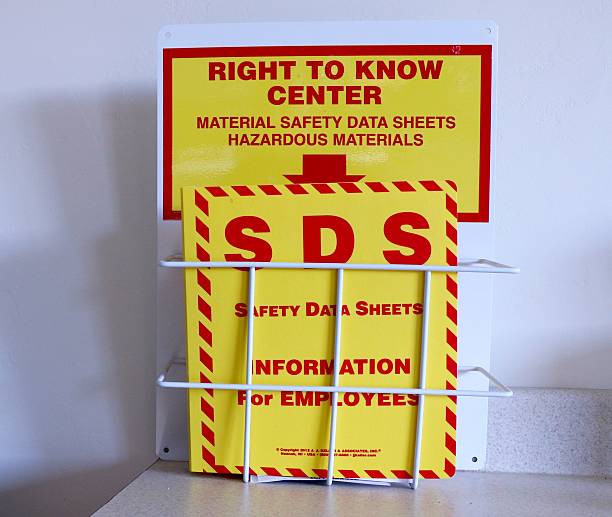
Material Safety Data Sheet (MSDS)
A Material Safety Data Sheet, now usually called a Safety Data Sheet (SDS), is the standard document that describes a product's hazards and how to handle it safely. It travels with the product through storage, shipping and use.
What it covers
Under the Globally Harmonized System (GHS), an SDS follows a set 16-section format, including:
- product and supplier identification
- hazard classification and labelling
- composition and ingredients
- first-aid and fire-fighting measures
- handling, storage and spill response
- exposure controls and protective equipment
- physical and chemical properties, such as flash point
- toxicological and environmental information
- disposal, transport and regulatory information
Why buyers ask for it
Many aromatic oils are flammable, and some can irritate or sensitise skin. The SDS tells warehouse staff, carriers and customs authorities how to store and move the product, and it tells manufacturers what precautions to take on their production line. A complete, current SDS is a normal requirement for importing and for compliance checks.
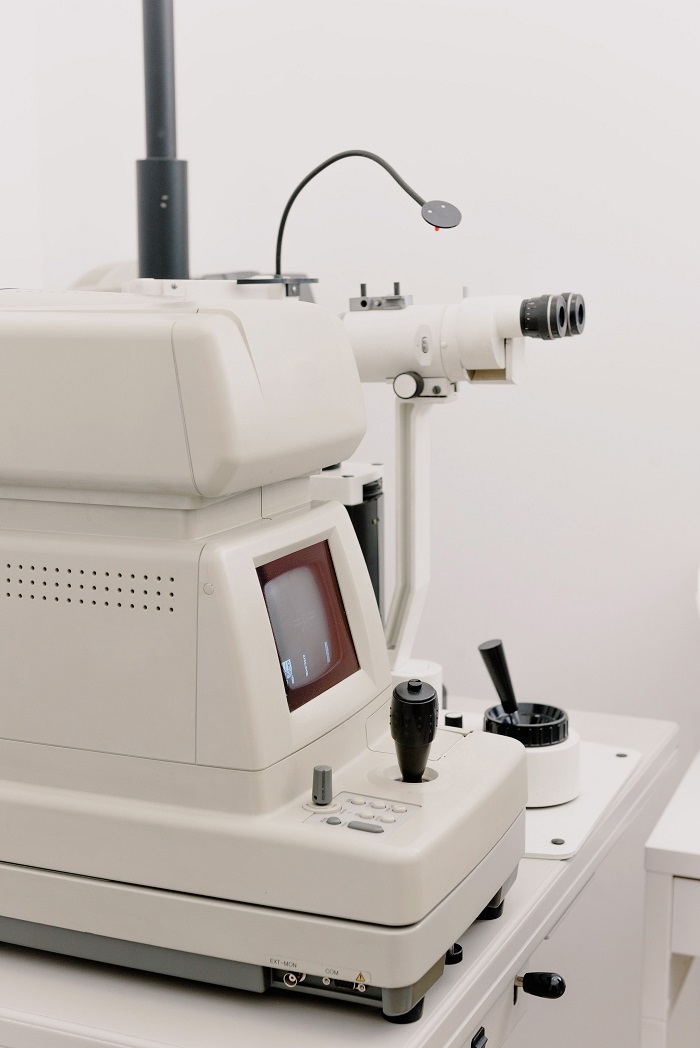
Optical Rotation
Many of the molecules in natural aromatic oils are "chiral", meaning they exist in left- and right-handed forms that are mirror images of each other. Such molecules rotate the plane of polarised light, and optical rotation measures how far and in which direction.
How it is measured
A polarimeter sends polarised light, normally of a fixed wavelength, through a tube of known length holding the sample at a controlled temperature. The instrument reports the angle through which the light has turned, in degrees.
- A positive (+) reading means the light is turned clockwise (dextrorotatory).
- A negative (−) reading means it is turned anticlockwise (levorotatory).
Why it matters
Each natural oil has a characteristic range of rotation, because it reflects the mix of chiral compounds the plant produced. For example, citrus oils rich in limonene read strongly positive, while lavender oil reads slightly negative. That makes optical rotation a quick, inexpensive purity check:
- a reading outside the expected range can point to dilution or adulteration
- synthetic versions of some compounds contain equal amounts of both mirror forms, so they rotate light very differently from the natural material
- it complements gas chromatography: GC shows what is in the oil, while rotation reveals the form those molecules take
Because rotation changes with temperature and tube length, results are always reported together with the conditions they were measured under.

Specific Gravity
Specific gravity compares the density of a material with the density of water at a stated temperature. It is a simple number with no units: water is 1.000, lighter materials read below it and heavier materials above.
How it is measured
The usual instruments are a pycnometer, a precisely calibrated glass flask that is weighed empty, filled with water and filled with the sample, or a digital density meter. Temperature is held steady, because density changes as an oil warms or cools.
Why it matters
Every pure essential oil has an expected range, shaped by what it contains. Citrus oils, rich in light terpenes, are lighter than water, while oils such as clove, rich in heavier compounds, are denser than water. That makes the reading useful for:
- Purity screening: a value outside the expected range can reveal dilution with a carrier or solvent.
- Batch consistency: the same oil should give a closely matching reading every time.
- Practical conversion: it links weight to volume, which matters when filling, pricing and shipping oils by the kilogram or by the litre.
Specific gravity cannot identify an oil on its own, so it is read together with other tests such as gas chromatography and optical rotation.
Achievements & Milestones

Industry Award 2023
Recognized for excellence in fragrance innovation and sustainability.

ISO Certified
Ensuring quality and consistency across all products and processes.

500+ Clients
Serving diverse industries across the globe with our premium solutions.
Committed to Quality

Certifications
Questions About Our Laboratory?
Get in touch and our team will be happy to answer your questions.
Send an Enquiry